


Imagine holding your smartphone, but instead of looking at a glowing screen, you're interacting with a device that feels more like magic. The idea of screenless smartphones might sound like something from a science fiction movie, but it's closer to reality than you might think. As technology continues to evolve at a breathtaking pace, the question isn't just "could we?" but rather "when will we?" have phones without traditional screens.
The Vision of Screenless Technology
For over a decade, we've been conditioned to think of smartphones as glass rectangles that light up with apps and notifications. But what if that was just one chapter in the story of mobile communication? Screenless smartphones represent the next chapter – a future where our devices could use holographic displays, augmented reality glasses, voice interfaces, and advanced haptic feedback to create experiences that feel more natural and intuitive than tapping on glass.
Think about how you use your current phone. You look at it, touch it, and sometimes talk to it. A screenless phone would take these interactions and make them feel more like conversations with a helpful companion rather than interactions with a piece of technology. The screen itself might disappear, but your connection to information, people, and services would become even stronger.
Holographic Displays: Bringing Images to Life
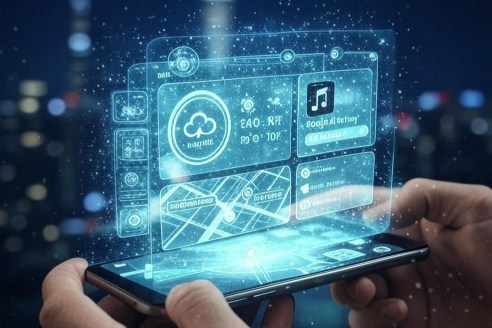
One of the most exciting possibilities for screenless phones is holographic technology. Instead of looking at a flat image on a screen, you could see three-dimensional projections floating in the air around you. Early versions of this technology already exist in research labs and high-end presentation systems.
How would this work? Tiny projectors in your phone could create light patterns that look like solid objects floating in space. You could "touch" a holographic button, rotate a 3D model of a product you're thinking about buying, or watch a movie where characters seem to be right there in the room with you. The technology behind this involves lasers, special mirrors, and advanced computer calculations that trick your brain into seeing something that isn't physically there.
The advantages are clear: no more cracked screens, no more glare from sunlight, and the ability to share what you're seeing with everyone around you without crowding around a small display. A holographic message from a loved one could appear as if they're standing right there with you. Navigation directions could appear as floating arrows showing you exactly where to turn.
Augmented Reality Glasses: Your Personal Display
Another approach to screenless phones involves augmented reality (AR) glasses. In this scenario, your phone becomes a small, powerful computer that you keep in your pocket, while a pair of smart glasses serves as your display. These glasses could project information directly into your field of vision, blending digital content with the real world around you.
Imagine walking down the street and seeing restaurant reviews floating next to each establishment, or having cooking instructions appear right above your kitchen counter as you prepare a meal. AR glasses could show you text messages without ever taking your eyes off what you're doing, or display a virtual screen that only you can see for private browsing or movie watching.
The technology for this already exists in early forms. Companies like Google, Apple, and Microsoft have been developing AR glasses for years. The current challenges are making them comfortable, stylish, and affordable enough for everyday use. But as the technology improves and prices come down, AR glasses could become as common as smartphones are today.
Voice Interfaces: The Power of Conversation
Remember when talking to your phone felt strange? Now voice assistants like Siri, Alexa, and Google Assistant have made voice control a normal part of using technology. For screenless phones, voice would become the primary way of interacting. Instead of tapping icons, you'd simply say what you want.
This shift would make technology more accessible to people who have difficulty using touchscreens, including older adults and people with certain disabilities. It would also allow for more natural, conversational interactions. Instead of navigating through menus, you could just ask for what you need: "Find me a recipe for chocolate chip cookies," or "Show me photos from my vacation last summer."
Advancements in artificial intelligence mean these voice systems are getting better at understanding context, emotion, and complex requests. They're learning to recognize different voices in a household, understand accents, and even detect when you're asking for something urgently versus casually. As this technology improves, it could make screen-based interfaces feel as outdated as rotary telephones.
Haptic Feedback: Feeling the Digital World
If you can't see a screen, how do you know you're touching the right thing? This is where haptic feedback comes in – technology that creates the sensation of touch through vibrations, movements, and other physical feedback. Modern smartphones already use basic haptics for vibration alerts, but future systems could be much more sophisticated.
Advanced haptic technology could make you feel like you're pressing physical buttons on a flat surface, or give you the sensation of texture when you're "touching" a digital object. Some research even explores creating the feeling of resistance – like you're pushing against something solid – or temperature changes to make digital experiences feel more real.
For a screenless phone, haptics could work together with voice commands. You might speak a command to open your messages, then feel vibrations in specific patterns to navigate through them. Different types of notifications could have distinct vibration signatures, so you'd know whether you're receiving a text message, email, or phone call without ever looking at a device.
The Technical Challenges We Need to Overcome
While the concept of screenless phones is exciting, there are significant technical hurdles that need to be addressed before they become everyday reality. Battery life is a major concern – holographic displays and AR glasses require a lot of power. Researchers are working on more efficient projection systems and better batteries, but this remains a challenge.
Privacy is another important consideration. With screens, you have a clear visual boundary – only you can see what's on your phone unless you show someone. With holographic displays or AR glasses, your information could be visible to people around you. Solutions might include directional projection that only you can see, or privacy screens that limit viewing angles.
Cost is always a factor with new technology. Early screenless devices would likely be expensive, just like the first smartphones were. But as production scales up and technology improves, prices would eventually come down to levels that most people can afford.
How Would We Use Screenless Phones?
Let's imagine a typical day with a screenless smartphone. You wake up and instead of reaching for your phone on the nightstand, you put on your AR glasses or simply speak to the room. Your schedule for the day appears in your field of vision as you get ready. As you make breakfast, recipe instructions float above your kitchen counter.
During your commute, navigation arrows appear on the road ahead of you, visible only through your glasses. At work, you can pull up documents and spreadsheets as virtual screens that you can resize and move around with hand gestures. Video calls become more immersive, with holographic representations of colleagues appearing to sit around a table with you.
In the evening, you watch a movie that appears as a large screen on your living room wall, projected from a small device in your pocket. When you receive a message from a friend, their face appears as a small hologram that you can interact with naturally. Throughout all this, you're never staring down at a small glass rectangle – you're engaging with the world around you while staying connected.
The Human Factor: Will People Accept Screenless Phones?
Technology adoption isn't just about what's possible – it's about what people are comfortable using. We've spent years getting used to touchscreens. They're simple, direct, and give us immediate visual feedback. Transitioning to screenless interfaces would require a shift in how we think about interacting with technology.
Some people might find voice control uncomfortable, especially in public places. Others might worry about the social implications of walking around with AR glasses on all the time. There would be a learning curve as people adapt to new ways of doing familiar tasks like texting, browsing the web, or taking photos.
However, history shows us that people can adapt to new technologies surprisingly quickly when the benefits are clear. Think about how rapidly smartphones replaced basic cell phones, or how touchscreens replaced physical keyboards on most phones. If screenless technology offers clear advantages in convenience, accessibility, and capability, adoption could happen faster than we expect.
The Environmental Impact
One unexpected benefit of screenless phones could be environmental. Smartphone screens are complex to manufacture and difficult to recycle. They contain rare materials and require energy-intensive production processes. By eliminating the screen, future devices could potentially be simpler to make, easier to repair, and more environmentally friendly.
Without a fragile glass screen, phones might also last longer. Screen damage is one of the most common reasons people replace their phones. More durable devices would mean less electronic waste and fewer resources consumed in manufacturing replacements.
Smaller, simpler devices might also use less energy overall, especially if they rely more on voice input and audio output rather than power-hungry displays. While holographic and AR technologies currently require significant power, future advancements could make them more efficient than today's high-resolution screens.
When Could We See Screenless Phones?
Realistically, we're looking at a gradual transition rather than an overnight change. We're already seeing elements of screenless technology in today's devices. Smart speakers without screens have become common in many homes. AR features are built into many smartphone apps. Voice assistants continue to improve.
Within the next five years, we'll likely see more devices that combine traditional screens with screenless features. Phones might have basic holographic capabilities for specific functions while keeping a traditional screen for others. AR glasses will become more common as secondary displays.
In ten to fifteen years, we might see the first truly screenless phones enter the mainstream market. These would be devices designed from the ground up to work without traditional displays, relying instead on the combination of technologies we've discussed. They would likely coexist with traditional smartphones for a while, much like tablets and laptops coexist today.
The Broader Implications
The shift to screenless technology could have effects beyond just how we use our phones. It could change how we design our living and working spaces. Without the need to look down at screens, we might design furniture and environments differently. Public spaces might incorporate shared holographic displays or AR enhancements.
Education could be transformed. Instead of students staring at tablets or computer screens, learning could happen through interactive holograms and AR experiences that make abstract concepts tangible. Medical training could use holographic models of human anatomy that students can examine from all angles.
Social interactions might evolve too. Instead of people gathered around a phone screen to look at photos, those photos could appear as holograms that everyone can see and interact with. Family video calls could become more like family gatherings, with participants appearing as life-sized holograms in your living room.
Conclusion: A Future Without Screens?
So, would smartphones without screens be possible? The answer is increasingly leaning toward yes. The technology is developing rapidly, and many of the pieces already exist in various forms. Holographic displays, AR glasses, sophisticated voice interfaces, and advanced haptic feedback are all areas of active research and development.
The bigger question is not whether screenless phones are possible, but whether they're desirable. Will people embrace this new way of interacting with technology? Will it truly improve our lives, or just add complexity? The success of screenless technology will depend on making it intuitive, affordable, and genuinely useful – solving real problems rather than just being novel.
What seems certain is that the way we interact with our devices will continue to evolve. Whether through screens or screenless interfaces, the goal remains the same: to connect us with information, with each other, and with the world around us in ways that feel natural and empowering. The journey from glass rectangles to whatever comes next will be one of the most fascinating technological stories of our time.
As we stand on the brink of this potential transition, it's worth remembering that every major change in personal technology has brought both challenges and opportunities. The move to screenless phones, if and when it comes, will be no different. It will require us to adapt, to learn new ways of doing familiar things, and to think differently about our relationship with technology. But it also holds the promise of making that relationship more seamless, more integrated into our lives, and perhaps even more human.